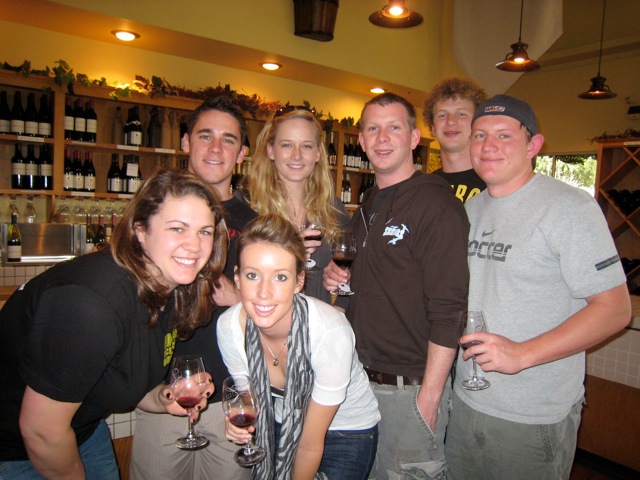
Due to a weekend trip to the Bay Area, it’s been a few days since I posted an entry, but now that I’m back home, here is REW’s entry into my contest. Because of a few last minute back outs, this is the last entry I’ve got, so next Monday will be the end of this contest. REW has a successful blog of his own, has written a book, and recently appeared in the New York Times, so he’s a good writer, but will he be able to get the support needed to win this contest? Let’s find out.
“You want some cheese with that whine?” By: REW
I’ve heard a lot of great lines uttered—or, more than occasionally, screamed—by baseball players, coaches, umpires and fans. Very few of them had anything at all to do with the subject of this blog. Some of them wouldn’t be fit to print here, knowing the delicate sensibilities of the readership. But one line (although not a great line) did bring baseball and wine together—sort of.
The coach of the Malibu Red Sox, a local Little League team, had a favorite expression to use with his eight-year-old players. (Older and less cultured readers may be interested to know that this particular coach had non-starring roles in Dude, Where’s My Car? and Baseketball.) Whenever a player would complain—about anything—the coach would say, “You want some cheese with that whine?” No doubt the predominant message was supposed to be “stop complaining,” but the secondary message, delivered thirteen years before the players on the team would be able to appreciate it legally in most jurisdictions of the United States, was “wine and cheese are commonly paired together to admirable effect.”
Thus we come, at last, to the subject of this post: wine and cheese (not, as you may have been thinking, the promotion of under-age drinking). The two do go together very well.
For reasons that probably have a lot to do with long histories of agricultural experimentation, cultures that produce a wide variety of wines also generally produce a wide variety of cheeses. Think of France. Charles de Gaulle, the first president of France’s Fifth Republic, famously said, “How can you govern a country which has 246 varieties of cheese?” He almost certainly underestimated—the number of varieties of cheese, that is, not the difficulty of governing France. Everyone knows Brie. Some know Boursin and Chevres. But what about—just for starters—Fougerus, Livarot, Mimolette, Pas de l’Escalette, Raclette, Saint-Nectaire, Saint-Paulin, Taupiniere, and Vignotte? Then there’s Italy, which has not only Mozzarella, Gorgonzola, Parmigiano, and Ricotta, but Ragusano, Taleggio, Caciotta, Ubriaco, and hundreds more. (Yes, “ubriaco” means “drunk” in Italian. Formaggio ubriaco is soaked in wine and then covered in the crushed grape skins left from making wine.)
In a culture with many wines and just as many cheeses, the possibilities for pairings are almost endless. (As I heard as least one member of the Malibu Red Sox say in response to his coach’s memorable line, “Why, yes, I would like some cheese with my wine.”) My own favorite pairings involve full-bodied red wines with full-flavored cheeses, like the ones I’m enjoying at the moment: pecorino cheese with Cabernet Sauvignon. (I’d prefer an Italian wine—maybe a Rosso de Montepulciano—with this distinctively Italian cheese, but my very domestic Cabernet works just fine.)
At the risk of putting the cheese before the wine in a wine blog, I need to say more about pecorino. As the name implies—at least to Italians—pecorino cheese is made with sheep’s milk. It takes on different characteristics—including flavors—depending in part on the length of time it is aged. Fresh pecorino is softer and milder. Aged pecorino (stagionato) is harder and more pungent; sometimes it is grated as a topping for pasta dishes, much like Parmigiano is. Either way, fresco or stagionato, pecorino is great with a bold red wine. One of my favorite antipasti is pecorino cheese cut into small rectangles (think two bites) and topped with a few drops of honey, a few pine nuts, and a few short stalks of fresh chives. (The honey complements the pecorino perfectly—and keeps the pine nuts and chives from falling off.) Open a bottle of Sangiovese or Nero d’Avola (or, if possible, Brunello) and it may be hard to think about moving beyond the antipasti. (I must thank the incomparable Elizabeth Whatley for this wonderful, and very simple, pecorino recipe.)
One of the best things about food and wine is the way our senses of taste and smell stimulate memory. Particular foods and wines often make us think of special times. A bottle of Brunello, for example, makes me think of a wonderful meal in a restaurant called Il Grappolo Blu in Montalcino. Putting wine and cheese together is good—and maybe even necessary—in part because it reminds us of times when dinner was a loaf of bread, a bottle of wine, and a hunk of cheese. And that dinner, for most of us who’ve had the experience, was always a special one because it was enjoyed with special people in special places: on a hillside in Tuscany, beside a canal in Provence, at an open-air concert at Wolftrap or Tanglewood, or on a trail in Yosemite.
A bottle of wine, a wedge of cheese, and maybe a baguette or a piece of foccaccia: the combination leaves no reason to whine.